Why Bend Radius Matters More Than Most Engineers Think
In pneumatic conveying systems, engineers often focus heavily on blowers, rotary valves, filters, and control systems. But one of the most overlooked, yet performance-critical, components is the bend radius within pipework.
At first glance, a bend is just a directional change in a pipeline. However, the radius of that bend directly influences:
- Material velocity
- Impact zones
- Wear rates
- Energy consumption
- Product degradation

For industries such as milling, plastics, grain handling, and food production, understanding bend radius is not a minor design detail, it’s a major operational factor.
In this article, we explore why bend radius matters more than most engineers think and how proper specification can dramatically improve system longevity and performance.
The Physics Behind Bend Radius
In a straight section of pipe, conveyed material typically travels at a relatively stable velocity. Once it reaches a bend, however, the physics changes dramatically.
Material particles:
- Continue travelling in a straight line due to inertia
- Are forced to change direction abruptly
- Impact the outer wall of the bend
The tighter the bend radius, the more aggressive this directional change becomes.
What Happens in a Tight Bend?
When a short-radius or standard elbow is used:
- Particle velocity spikes locally
- Impact energy concentrates in a smaller zone
- Abrasion intensifies at the outer wall
- Turbulence increases
This creates a high-wear “impact zone” that becomes the primary failure point in many pneumatic systems.
Velocity: The Hidden Multiplier
Velocity is one of the biggest contributors to pipework wear.
In pneumatic conveying, velocity must be high enough to keep material suspended but excessive velocity dramatically increases wear rates. Tight bends amplify this issue.
Why?
Because:
- Centrifugal forces increase in smaller radii
- Material slams into the outer wall at higher impact angles
- Velocity vectors change abruptly
- Particle-to-wall friction intensifies
Even a small increase in velocity can exponentially increase wear.
In practical terms:
- Doubling velocity can more than double wear rate
- Abrasive materials (e.g., flour, cement, plastic pellets, grain) accelerate erosion
- Fine powders can behave like sandblasting media at high speeds
A larger bend radius reduces the severity of directional change, lowering impact intensity and distributing wear more evenly.
Understanding Impact Zones
Every pneumatic conveying bend develops a wear pattern. But not all bends wear the same way.
Tight Radius Bends
- Create concentrated impact points
- Develop thin spots quickly
- Fail unpredictably
- Often require frequent replacement
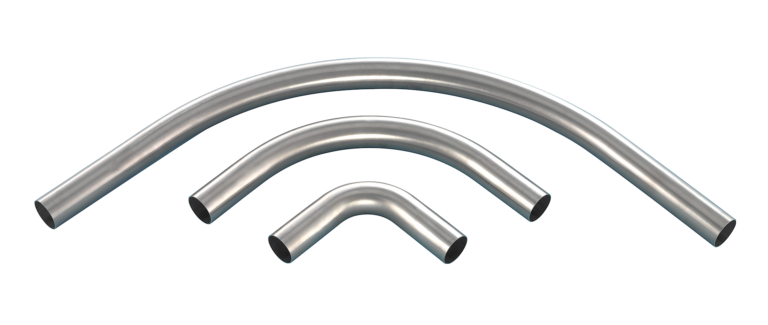
Large Radius Bends
- Spread particle impact over a wider area
- Reduce peak wall stress
- Lower localised erosion
- Increase service life
Instead of a single aggressive impact point, long-radius bends allow material to transition more gradually through the curve.
This reduces:
- Shock loading
- Surface fatigue
- Premature perforation
For abrasive applications, this difference can significantly extend operational lifespan.
Wear Rates: The True Cost of Poor Bend Design
Many engineers focus on initial component cost. However, the true cost of pipework lies in:
- Downtime
- Maintenance labour
- Production losses
- Emergency call-outs
- Replacement frequency
Short-radius bends typically show:
- Faster wall thinning
- Higher failure frequency
- Greater maintenance intervention
Over time, the cumulative cost of replacing worn elbows far exceeds the upfront saving.
In contrast, large-radius bends offer:
- Extended service intervals
- Predictable wear patterns
- Reduced unplanned shutdowns
- Lower total lifecycle cost
In abrasive systems, the difference can mean replacing components annually versus every few years.
Energy Efficiency and Pressure Drop
Bend radius doesn’t only affect wear, it also impacts system efficiency.
Tighter bends increase:
- Turbulence
- Pressure drop
- Energy demand
When airflow is disrupted, blowers must work harder to maintain conveying velocity.
This results in:
- Increased power consumption
- Higher operational costs
- Reduced system efficiency
Larger radii promote smoother airflow transitions, helping maintain consistent velocity profiles and reducing unnecessary energy loss.
Product Integrity: An Often-Ignored Factor
In food, grain, and fragile material applications, bend radius affects not just equipment life but also product quality.
Tight bends can cause:
- Particle breakage
- Attrition
- Dust generation
- Reduced product yield
For products like:
- Breakfast cereals
- Plastic pellets
- Fragile grains
- Powdered food ingredients
Excessive impact forces degrade material quality.
Long-radius bends allow a gentler transition, reducing impact stress on the product and preserving integrity.
When Should Engineers Specify Large Radius Bends?
Large radius bends are particularly important in:
- High-velocity systems
- Abrasive material conveying
- Food-grade and fragile products
- High-throughput production lines
- ATEX-rated environments
- Systems where downtime is costly
They are especially valuable where:
- Maintenance access is limited
- Line-side replacement is difficult
- Continuous production is required
In many cases, specifying long-radius bends at the design stage prevents expensive retrofitting later.
Common Mistakes in Bend Selection
Engineers often fall into predictable traps when specifying pipework:
- Choosing bends based solely on price
- Using standard elbows across all applications
- Ignoring velocity calculations
- Failing to analyse wear hotspots
- Underestimating lifecycle costs
Pipework should be treated as a performance component, not a commodity.
A Smarter Approach to Bend Specification
To optimise performance, engineers should consider:
- Material type and abrasiveness
- System velocity
- Pressure rating
- Product fragility
- Maintenance intervals
- Environmental classification (e.g., ATEX)
Working with a technical partner early in the design phase allows proper routing optimisation and component selection before installation begins.
How APT Systems Supports Division 3 Pipework & Fittings
At APT Systems, we understand that bends are not just connectors, they are high-stress performance components.
Our Division 3 pipework and fittings solutions include:
- Large-radius bends
- Stainless steel pipe systems
- Aluminium pipework
- Glass pipe sections for specialist applications
- Couplings and fittings
- CNC cold-bent solutions to prevent creasing
- 3.1 material certification and traceability where required
We work with contractors, OEMs, and engineers to:
- Identify high-wear impact zones
- Optimise routing before installation
- Reduce velocity-related erosion
- Improve system longevity
- Support compliance requirements
By focusing on engineering detail rather than just supplying parts, we help reduce operational risk and increase long-term reliability.

In pneumatic conveying, wear begins where direction changes. The sharper the change, the higher the stress.
Engineers who understand the relationship between velocity, impact zones, and wear rates can design systems that perform better and last longer.
APT Systems’ Division 3 team is always available to provide guidance on selecting the right pipework and fittings for your application.
If you are reviewing a pneumatic conveying system or planning a new installation, it may be worth asking:
Are your bends working with your system — or against it?