Designing Integrated Cooling Systems for Automotive & Motorsport Applications
Modern automotive and motorsport platforms demand more from thermal management systems than ever before. Whether in high-performance road cars, hybrid platforms, or competitive motorsport vehicles, cooling systems must deliver reliability under extreme pressure, temperature, and vibration.
Today’s challenge is no longer just about moving coolant from A to B. It’s about designing integrated cooling systems that optimise packaging, reduce weight, manage vibration, and ensure secure hose–pipe interfaces, all while meeting increasingly demanding performance standards.
In this blog, we explore the key considerations when designing integrated cooling systems for automotive and motorsport applications, with particular focus on PTFE hose technology, interface design, vibration management, and lightweight engineering.
The Shift Toward Integrated Cooling Architecture
Traditional cooling systems were relatively straightforward: radiator, pump, thermostat, hoses, and metal pipework. However, modern platforms now incorporate:
- Turbocharged ICE engines
- Hybrid battery cooling loops
- Oil cooling circuits
- Charge-air cooling systems
- Power electronics cooling
- Gearbox and transmission temperature management
This creates a network of interconnected fluid circuits operating at varying pressures and temperatures.
In motorsport applications, the demands are even more extreme:
- Sustained high RPM operation
- Rapid thermal cycling
- Aggressive cornering and G-forces
- Tight packaging envelopes
- Severe vibration loads
As a result, cooling system design must consider the entire system holistically, not as separate components, but as an integrated thermal solution.
Hose–Pipe Interfaces: A Critical Weak Point
One of the most overlooked aspects of cooling system design is the hose–pipe interface. Failures rarely occur in straight pipe sections, they typically occur at connection points.
Poorly designed interfaces can lead to:
- Coolant leaks
- Pressure loss
- Joint fatigue
- Premature hose degradation
- Warranty risk
Key interface considerations include:
- Material compatibility between hose and pipe
- Clamp or fitting selection
- Thermal expansion differences
- Pressure rating alignment
- Surface finish of hard lines
- Movement allowance under vibration
In high-performance and motorsport environments, rigid pipework often interfaces with flexible hose sections to accommodate movement and engine vibration. The challenge lies in balancing flexibility with secure sealing under pressure.
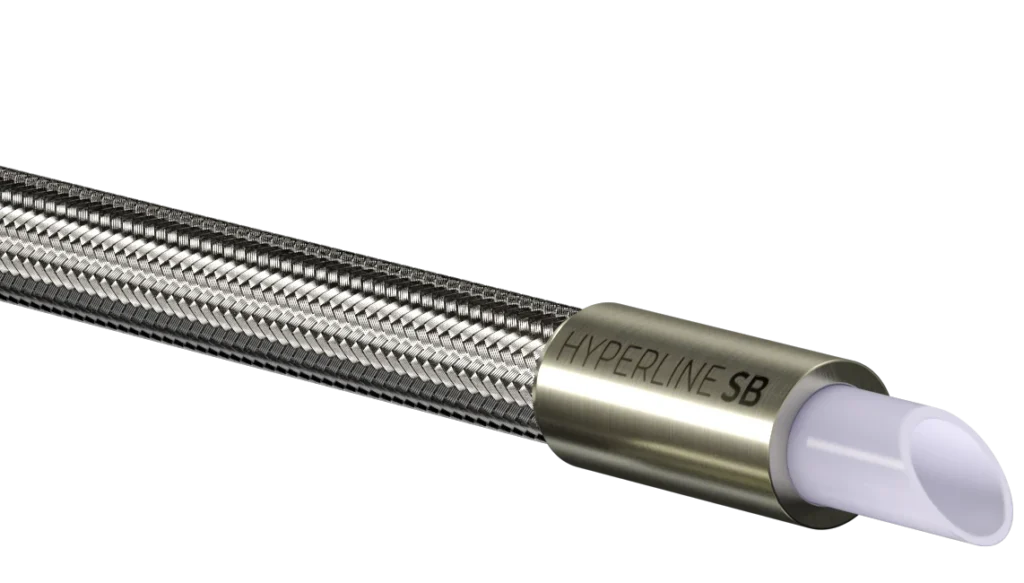
PTFE hose assemblies are increasingly specified in these environments due to their chemical resistance, temperature capability, and dimensional stability.
Why PTFE Hose Plays a Growing Role
PTFE (Polytetrafluoroethylene) hose offers significant advantages in integrated cooling systems, particularly where performance margins are tight.
Benefits of PTFE hose include:
- Excellent high-temperature resistance
- Superior chemical compatibility with modern coolants and oils
- Low friction internal bore for improved flow
- Resistance to ageing and hardening
- High pressure capability
- Lightweight construction compared to traditional reinforced rubber systems
In motorsport applications, PTFE hose is often preferred in:
- Oil cooling circuits
- Fuel systems
- Turbocharger cooling
- High-pressure coolant lines
Because PTFE maintains its mechanical properties across a wide temperature range, it reduces the risk of cracking or degradation under repeated thermal cycling.
Managing Vibration in Automotive Cooling Systems
Vibration is one of the most damaging forces within automotive and motorsport environments.
Sources of vibration include:
- Engine harmonics
- Road-induced shock
- Transmission oscillation
- High-frequency mechanical loads
Without proper damping, vibration can cause:
- Fatigue cracking at rigid joints
- Clamp loosening
- Seal failure
- Interface wear
An integrated cooling system must strategically use flexible hose sections to absorb movement and isolate rigid pipework from vibration stress.
Effective vibration control strategies:
- Introducing flexible PTFE hose between rigid pipe runs
- Avoiding over-constrained routing
- Allowing for controlled movement at connection points
- Designing for thermal expansion
- Supporting pipework with appropriate mounting brackets
By designing vibration mitigation into the cooling architecture from the outset, engineers reduce long-term reliability issues.
Weight Reduction Without Compromising Strength
Weight reduction remains a core objective across automotive and motorsport sectors. Every kilogram saved contributes to improved efficiency, handling, and performance.
Cooling systems present a significant opportunity for weight optimisation through:
- Lightweight aluminium hard lines
- PTFE hose assemblies with braided reinforcement
- Reduced wall thickness where structurally viable
- Integrated routing that eliminates unnecessary connectors
However, weight reduction must never compromise:
- Pressure capability
- Thermal durability
- Burst resistance
- Long-term fatigue strength
PTFE hose assemblies provide a strong balance between lightweight construction and high-performance durability, particularly in demanding environments.
Packaging and Space Constraints
Modern vehicles, particularly hybrid and high-performance platforms, are more tightly packaged than ever.
Cooling systems must navigate:
- Limited engine bay space
- Aerodynamic bodywork constraints
- Compact chassis designs
- Battery packaging zones
This requires:
- Custom-formed hose assemblies
- Precision hose–pipe transitions
- Careful bend radius consideration
- Integration with adjacent systems
In motorsport applications, packaging is even more aggressive, requiring compact, high-performance cooling solutions that withstand extreme loads.
Integrated design ensures that hose selection, routing, and pipe interfaces are optimised for both space efficiency and durability.
Designing for Long-Term Reliability
An integrated cooling system must perform not only under peak conditions but across the full service life of the vehicle.
Key reliability considerations include:
- Thermal cycling resistance
- Pressure fluctuation tolerance
- Chemical compatibility with evolving coolant formulations
- Resistance to abrasion
- Secure hose termination methods
Failure at a hose–pipe interface can have catastrophic consequences in both road and motorsport vehicles.
Early collaboration between system designers and hose specialists significantly reduces risk.
Motorsport vs Road Applications: Key Differences
While road vehicles prioritise durability and compliance, motorsport platforms emphasise:
- Performance under sustained load
- Rapid servicing capability
- Extreme temperature resistance
- Weight minimisation
In both cases, integrated cooling design principles remain the same:
- Secure interfaces
- Vibration isolation
- Material suitability
- Efficient routing
The difference lies in the tolerance levels. Motorsport simply operates closer to the edge.
Supporting Integrated Cooling System Design
At APT Systems, our division 1 Automotive department support integrated cooling system development through the supply of:
- Automotive-grade PTFE hose assemblies
- High-performance silicone hose solutions
- Precision hose–pipe interface components
- Lightweight fluid transfer solutions
We work alongside engineers and performance teams to ensure that hose selection supports:
- Thermal stability
- Vibration control
- Weight optimisation
- Long-term reliability
By understanding the interaction between hose materials, rigid pipework, and system dynamics, we help deliver cooling solutions suited to modern ICE, hybrid, EV, and motorsport platforms.
As vehicles become more powerful, more compact, and more thermally demanding, integrated cooling system design will remain a critical factor in long-term reliability and competitive performance.
If you are reviewing a cooling system design, it may be worth asking:
Are your hose and pipe interfaces engineered for integration — or simply connected?