
Anti-Static PTFE Hose: Why Static Dissipation Matters
Following on from our previous article about the advantages of PTFE fuel hose over rubber, we’re looking at another important consideration when selecting PTFE hose: electrostatic charge.
When you’re transferring fuel, chemicals or other low-conductivity fluids, static electricity isn’t something that should be overlooked. The movement of fluid through a non-conductive hose can generate electrostatic charge, and if that charge cannot safely dissipate, it can potentially discharge through the PTFE liner. In the wrong application, this can contribute to pinhole damage, leakage and, where flammable media are involved, a serious ignition hazard.
That’s where anti-static PTFE hose comes in.
What Is Static Electricity?
Static electricity is an electrical charge that builds up in one location rather than continuously flowing through a circuit.
It is different from the electrical current we use to power equipment, motors and other electrical systems.
In a hose application, static charge can be generated by the movement of the media through the hose. This is particularly relevant when transferring fluids with low electrical conductivity.
The amount of electrostatic build-up can depend on several factors, including:
- The fluid or media being transferred
- Flow velocity
- Turbulence
- Filtration
- Temperature
- Humidity
- The electrical properties of the hose liner
PTFE itself is an excellent electrical insulator. That’s one of its many useful properties, but it can also create a problem when a system needs to safely dissipate electrostatic charge.
Why Can Static Electricity Be a Problem in PTFE Hose?
As fluid moves through a PTFE hose, interaction between the media and the internal surface can generate electrostatic charge.
With a conventional non-conductive PTFE liner, that charge can accumulate rather than being safely carried away.
If the electrical potential becomes sufficiently high, a discharge can occur through the PTFE liner towards a conductive component or ground.
This can result in localised damage to the liner, sometimes producing a tiny hole or “pinhole”.
The problem with a pinhole is that it may initially be extremely small and difficult to detect, yet it can eventually develop into a fluid leak.
This is particularly concerning when the hose is carrying fuel, solvents, chemicals or other flammable media.
Static-dissipative PTFE hose is designed to provide a controlled path for electrostatic charge to reach the hose end connections and ultimately ground, rather than allowing the charge to build up within the liner.
Anti-Static Does Not Mean Electrically Conductive
This is an important distinction when specifying hose.
The terms anti-static, static dissipative and conductive are sometimes used interchangeably, but they shouldn’t automatically be treated as meaning exactly the same thing.
An anti-static or static-dissipative hose is designed to control and dissipate electrostatic charge.
An electrically conductive hose, meanwhile, is designed to provide a much more conductive electrical path.
The important thing is to select a hose based on the electrical requirements of the application, rather than simply choosing a hose because it is described as “conductive” or “anti-static”.
Electrical resistance and continuity should be considered alongside the media, pressure, temperature and hose construction. ISO 8031:2020 provides test methods for determining the electrical resistance and conductivity of rubber and plastics hoses and assemblies.
EN 16643:2016 and Anti-Static PTFE Hose
For applications involving fluoroplastic-lined hoses for chemical transfer, EN 16643:2016 provides requirements for the construction, performance and electrical properties of the hose assembly.
The standard recognises static-dissipative hose assemblies as part of its electrical classification. For an Anti-Static (AS) assembly, the electrical resistance is specified in the range of 10³ to 10⁸ ohms, when measured between the liner or outer cover and the opposite end fitting.
This is an important distinction when specifying anti-static PTFE hose. The fact that a hose has a black PTFE liner does not, by itself, prove that it meets an anti-static specification. The hose manufacturer’s declared electrical performance and relevant test results should always be checked.
How Anti-Static PTFE Hose Works
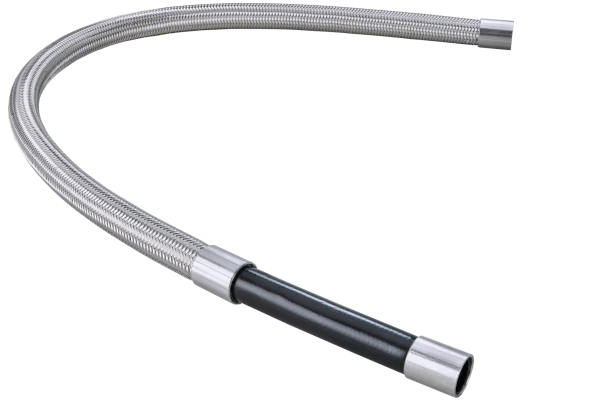
One of the most common approaches is to use a carbon-filled PTFE liner.
Instead of using standard insulating PTFE alone, the PTFE is modified to provide sufficient electrical conductivity for static dissipation.
This allows electrostatic charge generated within the hose to travel through the liner towards the hose end connection, where it can be safely discharged to ground when the overall system is correctly bonded and grounded.
This is fundamentally different from simply changing the external appearance of the hose.
And that leads to an important warning.
A Black PTFE Liner Doesn't Automatically Mean Anti-Static
Don’t assume that a black PTFE liner is automatically conductive.
The black colour of a PTFE liner does not, by itself, prove that the hose has the electrical properties required for static dissipation.
Black colouring can be achieved using pigments, whereas a genuine static-dissipative PTFE liner requires the appropriate formulation and electrical performance.
When specifying an anti-static hose, don’t rely on colour.
Instead, check the manufacturer’s technical data and the relevant electrical resistance testing or certification.
In other words: black doesn’t necessarily mean anti-static.
Anti-Static PTFE Hose for Fuel Applications
Fuel transfer is one area where static control can be particularly important.
Fuel and other low-conductivity fluids can generate electrostatic charge as they move through a hose, particularly at higher flow rates or where turbulence and filtration are involved.
For these applications, a static-dissipative PTFE liner can provide an important additional safety consideration by giving electrostatic charge a controlled route towards ground.
This makes anti-static PTFE hose a potential solution for applications involving:
- Fuel transfer
- Motorsport fuel systems
- Chemical transfer
- Solvent transfer
- Paint and coating systems
- Low-conductivity fluids
- High-flow fluid transfer
- Applications where electrostatic discharge is a known concern
The correct specification will always depend on the complete application.
Smooth-Bore or Convoluted Anti-Static PTFE Hose?
Anti-static PTFE hose isn’t limited to one construction.
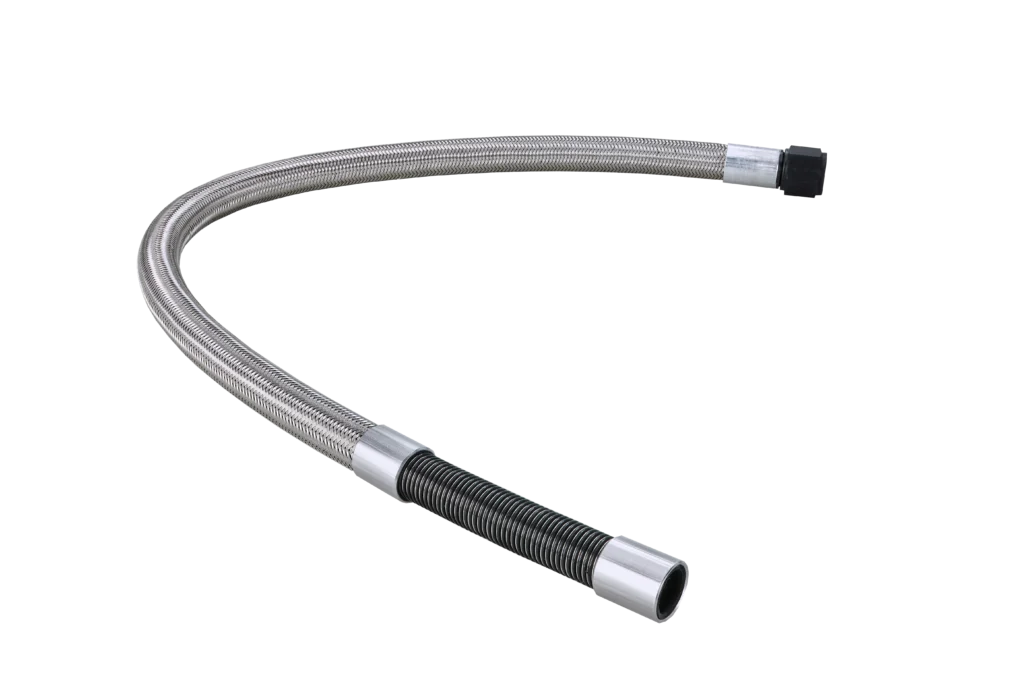
Depending on the application, static-dissipative PTFE liners can be incorporated into both smooth-bore and convoluted hose designs.
Smooth-bore PTFE
Smooth-bore hose provides a smooth internal surface and is often selected where low friction, cleanability and efficient flow are important.
Convoluted PTFE
Convoluted PTFE hose offers greater flexibility and can be useful where routing requires tighter bends or where the hose needs to accommodate movement.
Conductive versions of convoluted PTFE hose are available for applications where anti-static requirements need to be considered.
The choice should therefore be based on more than just the electrical properties of the liner.
Stainless Steel or Aramid Braid?
Anti-static PTFE hose can also be supplied with different reinforcement constructions.
For example, depending on the hose design and application, options can include:
Stainless steel braid
Stainless steel braided PTFE hose provides mechanical reinforcement and is widely used where pressure and temperature performance are important.
Aramid braid
Aramid reinforcement can provide a lightweight alternative where weight reduction is important. Fire-resistant constructions are also available for certain applications.
However, the outer braid should not be confused with the electrical function of the PTFE liner.
The key component responsible for static dissipation is the appropriately specified conductive/static-dissipative liner and the complete hose assembly’s electrical path.
Choosing the Right Anti-Static PTFE Hose
Selecting an anti-static hose isn’t simply a case of asking for “black PTFE”.
There are several factors that should be considered:
- Media: What fluid or chemical is being transferred?
- Electrical properties: Does the application create a static charge?
- Pressure: What working and peak pressures will the hose experience?
- Temperature: What are the minimum and maximum operating temperatures?
- Flow rate: Higher velocities can increase electrostatic charging.
- Bend radius: How tightly does the hose need to be routed?
- Flexibility: Is movement or vibration involved?
- Reinforcement: Stainless steel or aramid?
- End connections: How will the hose connect to the surrounding system?
- Grounding: How will the static charge ultimately be dissipated?
That final point is particularly important.
An anti-static hose does not operate in isolation. The hose assembly needs to be correctly specified, assembled and connected into a suitable grounding path.
Anti-Static PTFE Hose: Getting the Specification Right
When you’re dealing with fuel, chemicals or other potentially hazardous media, hose selection shouldn’t be based purely on pressure rating or temperature range.
The electrical properties of the hose can be just as important.
A standard PTFE liner can offer excellent chemical resistance, temperature performance and low friction, but PTFE is naturally electrically insulating.
Where static generation is a concern, a suitable static-dissipative PTFE construction can provide a controlled route for electrostatic charge to reach the hose end connections and ground.
The important point is that not all silicone tubing is interchangeable. The curing method, formulation, manufacturing process and certification should all be considered when specifying a product.
It is important to verify the actual certification of the specific silicone product rather than assuming that all platinum-cured silicone automatically meets every regulatory requirement.
The final material selection should always be based on the requirements of the application and the documentation supplied by the manufacturer.
At APT Systems, we can help customers select PTFE and silicone hose solutions for demanding automotive, motorsport and industrial applications, taking into account the media, temperature, pressure, flexibility and construction requirements.
If you’re specifying PTFE hose for fuel, chemicals or another application where electrostatic charge could be an issue, it’s worth checking that the hose you’re buying has the electrical properties your application actually requires.
Don’t choose anti-static PTFE hose by colour. Choose it by specification.