

How to Choose the Right Pipe Bend Radius for Pneumatic Conveying Systems
When designing a pneumatic conveying system, few components are as critical, yet often overlooked, as the pipe bend. Whether you’re transporting powders, granules, pellets, or any dry bulk material, the pipe bend radius you choose can significantly affect system efficiency, material integrity, wear rates, and overall energy consumption.
In this guide, we’ll walk you through everything you need to know to choose the right pipe bend radius for your system. We’ll cover definitions, practical considerations, key industry best practices, and how different materials and applications can impact your decision.
What Is Pipe Bend Radius?
Bend radius refers to the centreline radius of a pipe bend. It’s measured from the centre of the curve to the centreline of the pipe. This value is usually expressed in terms of the pipe’s diameter (e.g., 3D, 5D, 8D), where:
- 3D = 3 × Pipe Diameter
- 5D = 5 × Pipe Diameter
- 8D = 8 × Pipe Diameter
So, if your pipe is 100mm in diameter and you use a 5D bend, the bend radius will be 500mm.
The bend radius is critical because it influences:
- Velocity loss
- Material degradation
- System backpressure
- Wear rate at the outer bend wall
Why Bend Radius Matters in Pneumatic Conveying
In pneumatic conveying, material is moved through pipelines by air pressure or vacuum. That means every bend is a potential problem point.
Here’s why the bend radius plays such an important role:
1. Reducing Product Degradation
Tight bends (e.g., 1D–3D) cause sharp changes in direction, which can damage fragile materials like:
- Food products (cereal, coffee beans, sugar crystals)
- Plastic pellets
- Pharmaceutical powders
A larger radius (e.g., 5D–8D) reduces impact forces and turbulence, keeping product integrity intact.
2. Minimizing Wear and Erosion
Bends are subject to erosion, especially when conveying abrasive materials like:
- Cement
- Flour
- Sand
- Grain
A wider bend radius distributes material impact more evenly, reducing wear at the outer wall of the pipe. This leads to longer system life and less maintenance.
3. Reducing Pressure Drop
Each bend in your system creates resistance. A tight bend creates more turbulence, slowing down the air/material mixture and increasing pressure drop.
A larger bend radius helps:
- Maintain velocity
- Improve energy efficiency
- Reduce demand on blowers and vacuums
How to Choose the Right Pipe Bend Radius: Step-by-Step
1. Understand Your Material Characteristics
First, evaluate the material you’ll be conveying. Consider:
- Fragility – Is it prone to breakage or degradation?
- Abrasiveness – Will it cause high wear?
- Particle size and shape
- Bulk density
Rule of thumb:
- Fragile or abrasive materials → Use larger bend radii (5D–8D)
- Robust, smooth-flowing materials → Tighter bends (3D–5D) may be acceptable
2. Assess Conveying Type and Speed
Are you using dilute phase or dense phase conveying?
Conveying Type | Recommended Radius |
Dilute Phase (high speed, low pressure) | 5D–8D preferred |
Dense Phase (low speed, high pressure) | 3D–5D may be sufficient |
Faster-moving materials need gentler curves to minimize wear and breakage.
3. Evaluate System Layout and Space Constraints
Larger bend radii require more space, which might not always be available in retrofit or compact installations. If you’re constrained by layout, consider:
- Using back-to-back 45° bends instead of one tight 90° bend
- Custom elbows with optimized wear liners or diverter internals
4. Account for Wear and Maintenance
If you’re handling abrasive materials, even a large radius bend will wear out over time. Choose:
- Thicker-walled pipe in bends
- Ceramic-lined, hardened steel, or replaceable wear-back bends
- Wear monitoring ports for predictive maintenance
5. Follow Industry Standards and Best Practices
Most pneumatic conveying professionals recommend:
- Minimum bend radius of 5D for general use
- 8D or larger for highly abrasive or fragile materials
- Avoid 1D–2D bends unless necessary
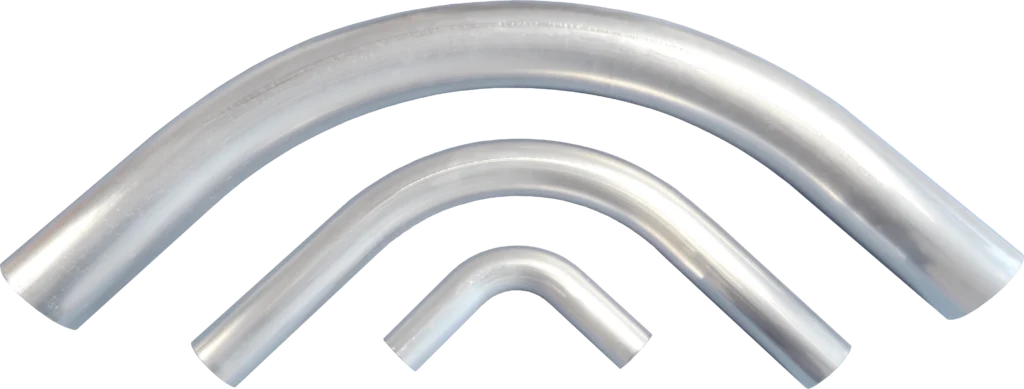
Example: Choosing a Bend Radius for a Plastics Plant
Material: Virgin plastic pellets
Pipe Diameter: 100mm
System Type: Dilute phase vacuum
Fragility: Moderate
Wear Concern: Medium (due to long runtime)
Recommended Bend Radius:
- 5D or 6D (500mm–600mm)
- Material: Aluminium or Stainless Steel with smooth inner finish
- Optional: Replaceable elbow sections for high-wear points
When to Use Specialty Bends
Some systems require custom or specialty pipe bends. These include:
➤ Long Radius Bends (8D–10D)
Used in food, pharma, or very abrasive materials to reduce degradation and dust generation.
➤ Segmented or Metered Bends
Cost-effective and compact but create more turbulence. Suitable only for non-fragile, low-wear applications.
➤ Swept Bends or Elbows with Vortex Inserts
Engineered for ultra-smooth flow, reducing turbulence dramatically. Great for high-speed dilute phase systems.
💡 Pro Tips
- Always keep the same inner diameter through bends to avoid flow restriction.
- If system performance drops, check elbows first as they’re often the first to fail.
- Document your radius choices. Consistency aids maintenance and troubleshooting.
Boost System Performance with the Right Bend Radius
Selecting the right pipe bend radius isn’t just a technical detail, it’s a critical design choice that affects your system’s efficiency, product quality, maintenance cost, and energy use.
By choosing a suitable bend radius based on your material, conveying speed, and system layout, you can:
- ✅ Improve product integrity
- ✅ Reduce energy consumption
- ✅ Extend system lifespan
- ✅ Minimize downtime and blockages
Need Help Specifying Pipe Bends?
APT Systems supply a wide range of pipe bends, elbows, and custom fittings for pneumatic conveying systems in plastics, food, milling, chemical, and dust handling industries.
👉 Contact our technical team today for advice, CAD drawings, or custom fabrication options.