
Platinum Silicone vs Peroxide Silicone in Biopharma, Pharmaceutical and Food Applications
When selecting silicone tubing or hose for biopharma, pharmaceutical and food applications, the choice of curing technology can be just as important as the silicone itself.
Silicone is widely used across high-purity fluid transfer applications because it offers excellent flexibility, temperature resistance, chemical stability and biocompatibility. However, not all silicone products are manufactured in the same way.
Two common curing methods are platinum curing and peroxide curing. Both can produce high-quality silicone, but they differ significantly in terms of extractables, leachables, cleanliness, transparency and suitability for sensitive applications.
For applications where product purity is critical, platinum-cured silicone is generally preferred because it provides a cleaner manufacturing route with fewer residual curing by-products.
In this blog, we look at the key differences between platinum-cured silicone and peroxide-cured silicone, and why the choice matters in biopharmaceutical, pharmaceutical, food and beverage processing.
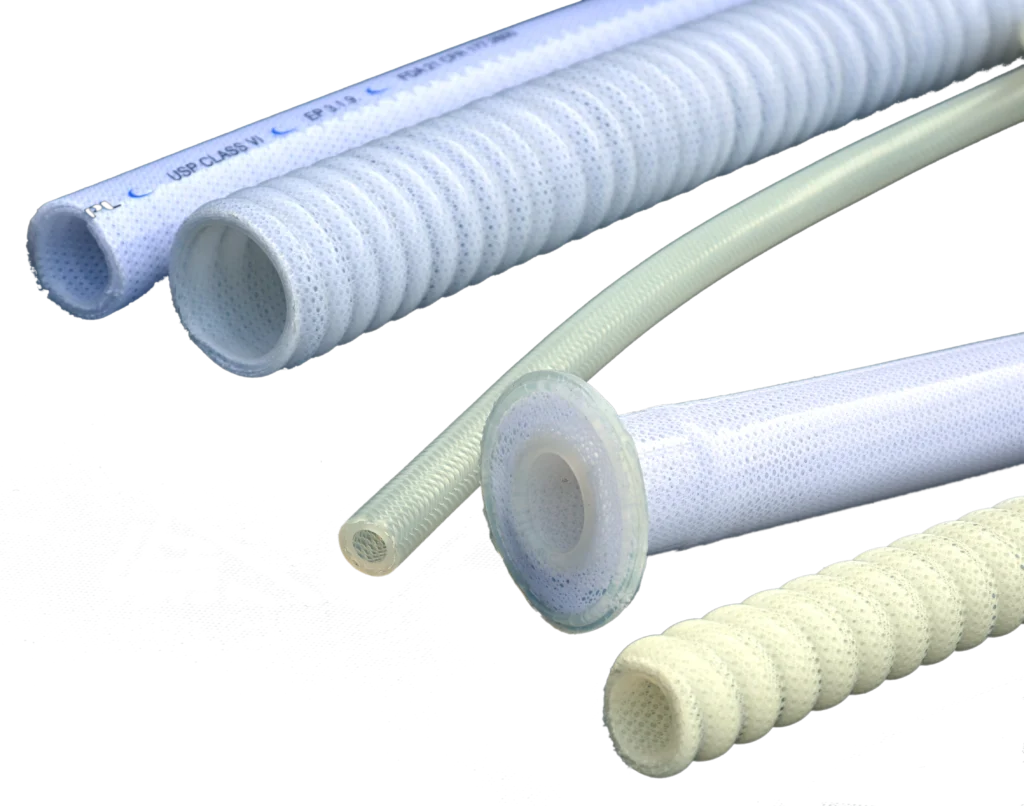
What Is Silicone Curing?
Silicone starts as a flexible polymer material that needs to be cured, or cross-linked, to achieve its final physical properties.
The curing process creates the three-dimensional structure that gives silicone its characteristic:
- Flexibility
- Elasticity
- Temperature resistance
- Chemical resistance
- Mechanical stability
The two curing technologies most relevant to high-purity silicone tubing and hose are platinum curing and peroxide curing.
The curing method can influence the level of residual substances within the finished silicone product. This is particularly important when the tubing comes into contact with:
- Pharmaceutical formulations
- Biologics
- Cell culture media
- Water for injection
- Food products
- Beverages
- Cosmetic formulations
- Other sensitive process fluids
This is where platinum-cured silicone can offer significant advantages.
What Is Platinum-Cured Silicone?
Platinum-cured silicone uses a platinum catalyst to initiate the cross-linking reaction.
The process is often described as a “clean chemistry” route because it does not rely on organic peroxide curing agents that can leave decomposition products behind.
The result is a silicone material with very low levels of residual substances, making it particularly attractive for high-purity applications.
Key benefits of platinum-cured silicone include:
- Very low extractables and leachables
- Excellent purity
- Minimal odour and taste transfer
- Excellent transparency
- High biocompatibility
- Consistent material performance
- Good suitability for sensitive pharmaceutical formulations
- Reduced risk of contamination from curing by-products
For applications where the integrity of the product being transferred is critical, these characteristics can be extremely valuable.
What Are Extractables and Leachables?
The terms extractables and leachables are particularly important within pharmaceutical and biopharmaceutical manufacturing.
Extractables
Extractables are substances that can potentially be removed from a material under controlled laboratory extraction conditions.
They help manufacturers understand what substances could potentially migrate from tubing, hoses, seals or other process-contact materials.
Leachables
Leachables are substances that actually migrate from a material into the process fluid during normal or simulated operating conditions.
This distinction is important because even very small quantities of unwanted substances can potentially affect sensitive products.
For example, contamination could potentially influence:
- Product stability
- Taste
- Odour
- Colour
- Chemical composition
- Biological performance
Using materials with low extractables and leachables can therefore help reduce the risk associated with product-contact components.
Why Platinum-Cured Silicone Has Lower Extractables
One of the main advantages of platinum curing is the chemistry involved in the curing process.
Because platinum-cured silicone does not rely on peroxide curing agents, there are fewer peroxide decomposition products that need to be removed from the finished material.
This can help provide a cleaner final product.
For manufacturers working with sensitive products, this can mean:
- Lower risk of unwanted substances migrating into the product
- Improved product purity
- Reduced potential impact on taste and odour
- Easier validation of product-contact components
- Reduced reliance on additional processing to remove residual substances
This is one of the reasons platinum-cured silicone is frequently selected for high-purity applications.
What Is Peroxide-Cured Silicone?
Peroxide-cured silicone uses organic peroxide compounds to initiate the curing reaction.
It is an established and widely used manufacturing process that can produce silicone with good mechanical and thermal properties.
However, the curing process can result in residual peroxide decomposition products within the silicone.
These can include substances such as:
- Acetophenone
- Benzoic acid derivatives
- Other peroxide decomposition products
- Volatile organic compounds
Some of these residual substances can be reduced or removed through additional post-curing processes.
This means peroxide-cured silicone can still be suitable for certain food, industrial and other applications, depending on the material specification, processing and regulatory requirements.
However, where extremely low extractables and high purity are required, platinum curing is often the preferred option.
The Importance of Post-Curing
Post-curing is a heat-treatment process used to remove residual volatile substances from silicone following the initial curing process.
This can be particularly important for peroxide-cured silicone.
Additional processing can help reduce residual peroxide decomposition products and improve the suitability of the material for certain applications.
However, platinum-cured silicone can provide an advantage because its curing chemistry produces fewer of these unwanted decomposition products in the first place.
This can simplify the route towards achieving the required cleanliness and purity.
For manufacturers, the important consideration is not simply whether a silicone product has been post-cured, but whether the complete material specification and manufacturing process meet the requirements of the intended application.
Platinum Silicone in Pharmaceutical Applications
Pharmaceutical manufacturing requires careful control of materials that come into contact with the product.
Silicone tubing is commonly used for applications such as:
- Fluid transfer
- Filling and dispensing
- Pump tubing
- Bioprocessing
- Sampling
- Media transfer
- Pharmaceutical manufacturing equipment
Platinum-cured silicone is often preferred because of its low extractables, excellent transparency and biocompatibility.
For sensitive formulations, reducing the possibility of unwanted substances migrating into the process can be an important part of maintaining product quality.
Platinum Silicone in Biopharmaceutical Applications
Biopharmaceutical processes can be particularly sensitive to contamination.
Applications can involve biologics, cell culture processes, vaccines, proteins and other highly sensitive materials.
The tubing and hose used within these systems must therefore be carefully selected.
Platinum-cured silicone can provide:
- Low extractables
- Low leachables
- Excellent biocompatibility
- High transparency
- Good flexibility
- Consistent performance
- Suitable temperature resistance
- Reduced risk from curing-related residues
Transparency can also be particularly useful because it allows operators to visually inspect fluid movement through the tubing.
This can help identify:
- Air bubbles
- Blockages
- Discolouration
- Particles
- Changes in fluid flow
Platinum Silicone for Food and Beverage Applications
Food and beverage processing also places strict demands on product-contact materials.
Silicone tubing may be used for transferring:
- Liquid food products
- Dairy products
- Beverages
- Syrups
- Ingredients
- Powders and suspensions
- Cleaning fluids
In these applications, unwanted taste, odour or colour transfer can be particularly problematic.
Platinum-cured silicone can help minimise these concerns due to its low residual contamination and clean curing chemistry.
Potential advantages include:
- Minimal taste impact
- Minimal odour transfer
- Excellent transparency
- Good flexibility
- High temperature resistance
- Good chemical resistance
- Suitability for hygienic applications
Platinum vs Peroxide Silicone: Pros and Cons
Property | Platinum-Cured Silicone | Peroxide-Cured Silicone |
Extractables / Leachables | Very low | Higher |
Odour / Taste Impact | Minimal | Possible |
Biocompatibility | Excellent | Good |
Transparency | Excellent | Moderate to good |
Pharmaceutical Use | Preferred | More limited depending on specification |
Food & Beverage Purity | Preferred | Suitable for certain applications |
Residual By-Products | Very low | Potential peroxide decomposition products |
Post-Curing Requirements | Often reduced | May require additional processing |
Initial Cost | Higher | Lower |
The Advantages of Platinum-Cured Silicone
For high-purity applications, platinum-cured silicone offers a number of important benefits.
Key advantages include:
- Lower extractables and leachables – reducing the potential for unwanted substances entering the process.
- Clean curing chemistry – fewer residual peroxide decomposition products.
- Excellent transparency – allowing easy visual inspection of fluid flow.
- Minimal odour and taste impact – important for food and beverage applications.
- Excellent biocompatibility – supporting demanding pharmaceutical and biopharmaceutical processes.
- Good regulatory suitability – platinum-cured products can be manufactured to meet relevant FDA, USP Class VI and European requirements, depending on the specific product and certification.
- Improved suitability for sensitive products – particularly where purity and contamination control are critical.
Which Silicone Should You Choose?
The correct silicone depends on the application.
Platinum-cured silicone is generally the preferred choice for:
- Biopharmaceutical processing
- Pharmaceutical manufacturing
- Sensitive fluid transfer
- High-purity applications
- Food and beverage product contact
- Applications where taste and odour are critical
- Processes requiring low extractables and leachables
- Applications requiring excellent transparency
Peroxide-cured silicone may be appropriate for:
- General industrial applications
- Less sensitive fluid transfer
- Applications where cost is a primary consideration
- Certain food applications where the specific material is suitably certified
- Applications where extractables requirements are less demanding
The important point is that not all silicone tubing is interchangeable. The curing method, formulation, manufacturing process and certification should all be considered when specifying a product.
Compliance and Certification
For pharmaceutical, biopharmaceutical and food applications, compliance documentation is an important part of material selection.
Depending on the application, customers may require evidence relating to standards and regulations such as:
- FDA requirements
- USP Class VI
- European food-contact requirements
- Material traceability
- Extractables and leachables data
- Batch documentation
- Product-specific compliance certificates
It is important to verify the actual certification of the specific silicone product rather than assuming that all platinum-cured silicone automatically meets every regulatory requirement.
The final material selection should always be based on the requirements of the application and the documentation supplied by the manufacturer.
How APT Systems Supports High-Purity Applications
At APT Systems, our hose and tubing solutions support demanding applications across the food, pharmaceutical and biopharmaceutical sectors.
We understand that selecting the right silicone is about more than simply choosing a flexible hose. The curing technology, cleanliness, chemical compatibility, temperature performance and required certification all need to be considered.
Our technical approach helps customers select appropriate solutions for applications where product purity and reliable fluid transfer are critical.
We can support requirements involving:
- Platinum-cured silicone hose and tubing
- Pharmaceutical fluid transfer
- Biopharmaceutical applications
- Food and beverage processing
- High-purity fluid handling
- Silicone and PTFE solutions
- Application-specific technical advice
Both platinum-cured and peroxide-cured silicone have their place within industry, but they are not identical when it comes to high-purity applications.
Platinum-cured silicone is generally preferred for biopharma, pharmaceutical and food applications where low extractables, minimal leachables, product purity and clean processing are priorities.
Its clean curing chemistry, excellent transparency, biocompatibility and low levels of residual substances make it particularly well suited to sensitive product-contact applications.
Peroxide-cured silicone can still be an effective and economical solution where the application allows for it, particularly when the material has been appropriately post-cured and meets the required specifications.
Ultimately, choosing between platinum and peroxide silicone should be based on the specific requirements of the application, including product sensitivity, regulatory requirements, extractables and leachables, operating conditions and required documentation.
For high-purity applications where cleanliness and product integrity are critical, platinum-cured silicone is often the preferred route.