Common Failure Points in Stainless Steel Pressure Transfer Systems
Pipework, Bends, and Fittings Under Pressure
Stainless steel pipework is widely used in pressure transfer systems due to its strength, corrosion resistance, and long service life. From compressed air and gas systems to liquid transfer and pneumatic conveying, stainless steel offer’s reliability in demanding industrial environments.
However, stainless steel systems are not immune to failure. When failures occur, they are rarely caused by the pipe material itself. Instead, problems typically arise from how the pipework is designed, routed, supported, and connected.
This article examines the most common failure points in stainless steel pressure transfer systems, with particular focus on long and short radius bends, compression couplings, Y-branches, T-pieces, and the system-level stresses that act on them.
Why Stainless Steel Pipework Fails in Pressure Systems
Stainless steel is strong and rigid, which makes it ideal for high-pressure applications, however, that rigidity also means it absorbs stress rather than flexing. When pressure fluctuations, vibration, or thermal movement are not correctly managed, stress concentrates at joints, bends, and fittings.
Over time, these stress concentrations lead to fatigue cracking, joint leakage, or sudden component failure.
1. Bends: Long Radius vs Short Radius
Bends are unavoidable in any pipework system, but they are also one of the highest-risk areas for failure.
Short Radius Bends
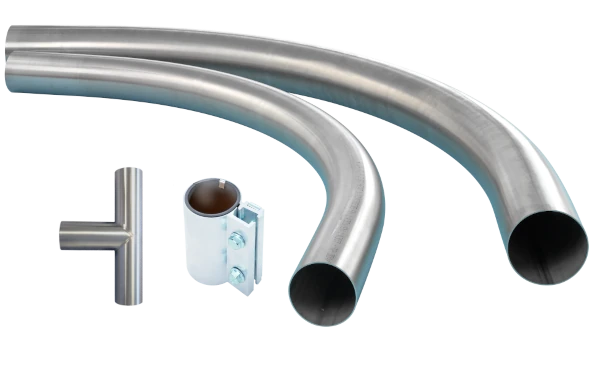
Short radius bends are often used where space is limited. While compact, they introduce higher turbulence and stress.
Common issues with short radius bends:
- Increased pressure drop
- Higher internal turbulence
- Localised erosion at the outer wall
- Stress concentration at welds or formed sections
- Accelerated fatigue under cyclic pressure
Short radius bends are particularly vulnerable in systems with high flow velocities or frequent pressure cycling.
Long Radius Bends
Long radius bends provide smoother flow transitions and reduced stress, making them preferable for pressure transfer systems wherever space allows.
Benefits of long radius bends include:
- Lower pressure loss
- Reduced turbulence
- Less erosion and wear
- Improved fatigue resistance
- Longer system lifespan
From a reliability perspective, long radius bends should be the default choice in stainless steel pressure systems, with short radius bends used only where unavoidable.
2. Compression Couplings and Mechanical Joints
Compression couplings are widely used in stainless steel pipework for their ease of installation and ability to create leak-tight joints without welding. However, they are also a frequent source of failure when misapplied.
Common causes of compression coupling failure:
- Incorrect pipe preparation or cutting
- Poor alignment during assembly
- Over-tightening or under-tightening
- Use outside the coupling’s pressure or temperature rating
- Repeated vibration loosening the joint
Unlike welded joints, compression fittings rely on consistent mechanical grip and sealing force. Any movement in the pipework caused by vibration, poor supports, or thermal expansion, can compromise joint integrity over time.
Proper support placement near compression couplings is critical to prevent micro-movement and long-term leakage.
3. T-Pieces and Y-Branches: Flow-Induced Stress
T-pieces and Y-branches introduce sudden changes in flow direction and velocity, making them natural stress concentrators.
T-Pieces
T-pieces are commonly used to distribute flow but can create dead zones and uneven pressure loading.
Failure risks associated with T-pieces:
- Turbulence at the branch intersection
- Erosion at impact points
- Uneven stress distribution
- Fatigue cracking at welded or formed junctions
Y-Branches
Y-branches offer a smoother flow path than T-pieces and are often preferred in pressure systems.
Advantages of Y-branches include:
- Reduced turbulence
- Lower pressure drop
- More even load distribution
- Improved long-term reliability
Where pressure stability and system longevity are priorities, Y-branches are generally the superior option, particularly in stainless steel pipework operating under cyclic loads.
4. Pipe Supports and Stress Transfer
Stainless steel pipework must be supported correctly to avoid transferring stress to bends and fittings.
Common support-related failure causes:
- Excessive distance between supports
- Rigid clamping preventing thermal movement
- Lack of axial restraints on pressurised lines
- Poor support placement near bends and fittings
Unsupported or poorly supported pipe runs allow movement that concentrates stress at joints, compression couplings, and directional changes. Over time, this leads to fatigue cracking or joint failure.
Supports should be designed to:
- Carry pipe weight
- Control vibration
- Allow controlled thermal expansion
- Protect fittings from mechanical load
5. Pressure Spikes and Transient Loads
Pressure spikes are one of the most damaging, and least visible, causes of failure in stainless steel pressure systems.
Typical sources of pressure spikes:
- Rapid valve closure
- Pump or compressor start-up
- Emergency shutdown events
- Sudden blockages or flow changes
Although stainless steel can tolerate high static pressures, repeated transient spikes accelerate fatigue, particularly at bends, T-pieces, and compression fittings.
Systems designed only for nominal operating pressure often fail prematurely when exposed to these transient conditions.
Poor Routing and Layout Decisions
Pipe routing has a direct impact on stress, accessibility, and maintainability.
Common routing mistakes:
- Excessive use of short radius bends
- Tight pipe clusters restricting movement
- Routing near vibration sources
- No allowance for expansion or contraction
- Limited access to joints and fittings
Good routing reduces stress, improves flow efficiency, and makes inspection and maintenance far easier, which are key factors in long-term reliability.
Summary Of Key Failure Points in Stainless Steel Pressure Systems
- Short radius bends in high-flow or cyclic systems
- Compression couplings without adequate support
- T-pieces exposed to high turbulence
- Poorly supported long pipe runs
- Stress from pressure spikes and thermal movement
- Routing that prioritises space over reliability

Final Thoughts
Stainless steel pipework is an excellent choice for pressure transfer systems, but only when the entire system is engineered correctly. Most failures occur not because stainless steel is unsuitable, but because bends, fittings, and supports are selected or installed without fully considering how pressure, flow, and movement interact over time.
By favouring long radius bends, supporting compression couplings, selecting Y-branches over T-pieces where possible, and designing for pressure spikes, organisations can dramatically improve system reliability and lifespan.
In stainless steel pressure systems, good design is the difference between decades of service and recurring failure.